

If you can tolerate the taste, Chirata can influence your biochemistry. It contains Amarogentin, recognized as the most bitter natural substance. This compound is detectable even when diluted to 1 part in 14,000,000.
The bitterness is more than a flavor—it serves as a biological alarm clock. Unlike the current wellness industry, which centers on sweet gummies and smoothies, Chirata delivers a noticeable jolt to your system. Across centuries, from Mughal Empire physicians to modern researchers investigating insulin resistance, consensus persists: its bitterness underlies its efficacy.
However, the benefits of chirata are at risk. Before you start using this herb, it’s important to know two things: how it affects your metabolism, and why buying the wrong type could harm the species. These foundational considerations lead us to an in-depth exploration of chirata’s chemistry and biological effects.
What is Chirata?
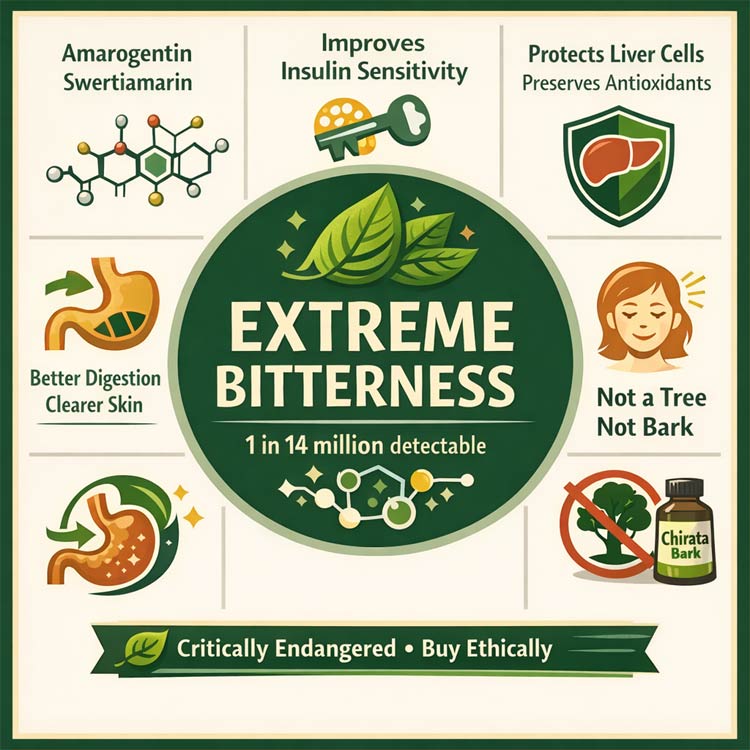
Chirata (scientifically known as Swertia chirayita) is a medicinal herb indigenous to the temperate Himalayas, traditionally used to regulate blood sugar, support liver health, and treat skin conditions. Its efficacy comes from Amarogentin and Swertiamarin. These 2 are active compounds that stimulate digestive enzymes, modulate insulin sensitivity, and reduce inflammation. Swertia chirayita is classified as Critically Endangered in many of its native habitats. As a result, ethical sourcing of cultivated plants is essential to avoid contributing to their extinction.
To understand the benefits of the chirata plant for your body, we must move beyond vague concepts of “detox” and examine the hard science. With this foundation in place, let’s look more closely at the key compounds that drive its effectiveness.
Not Just “Bitter”: Meet Amarogentin and Swertiamarin
Bitterness in nature signals caution. For Chirata, this bitterness acts as a chemical trigger that activates the liver’s defense systems.
- Amarogentin: This secoiridoid glycoside causes the plant’s intense bitterness. [1] Current research suggests it functions as a topoisomerase inhibitor, a mechanism that halts the replication of foreign pathogens (such as Leishmania).
- Swertiamarin: This compound is less bitter but affects the central nervous system and helps regulate insulin resistance.
The “Chirata Tree” Myth vs. Botanical Reality
There is a common misconception in search. Many people mistakenly believe there is a “chirata tree.” It’s important to clear up this mistake so you can find the right plant. An annual or biennial herb that grows to roughly 1.5 meters. It has a cylindrical stem and lanceolate leaves. If a product claims to be bark from a “chirata tree,” it is likely an adulterant. It might be Andrographis paniculata, a common and cheaper substitute known as “Kalmegh.” The medicinal potency is primarily in the stem and the chirata leaf, not in the wood or bark.
Now that we’ve clarified what Chirata is and what it is not, we can delve into four clinically backed health benefits. Chirata’s benefits connect traditional Ayurvedic ideas, such as “Pitta-balancing,” with modern science on metabolism. Here’s how it affects the body.
4 Clinically-Backed Health Benefits of Chirata
1. The Metabolic Reset: Sensitizing Insulin
Saying that Chirata simply “lowers blood sugar” is too simple. The way it works is more complex.
Chirata aids in sensitizing the body respond better to insulin. Studies show that its active parts help the pancreas release more insulin and help the body use glucose more effectively. Instead of just lowering blood sugar, it helps your body use it more healthfully. Test models have shown significant reductions in fasting glucose, but this mechanism generally relies on the presence of functional beta cells.
Diabetes is a rapidly increasing metabolic disorder. It is linked to poor insulin function. The existing treatments come with high costs, and possible side effects cannot be ruled out. Chirata (Swertia chirayita) has shown strong antidiabetic potential in traditional medicine, as per the study. [2] Further research is needed to confirm its safety, mechanism, and effective human use.
2. The Liver Shield: Architecture Protection
People often misuse the word “detox.” However, Chirata’s ability to protect the liver is well supported by research.
Chirata helps protect hepatocytes, the liver’s cells. Today, high intake of processed foods and alcohol increases liver stress. Chirata may preserve Glutathione, the body’s master antioxidant. This offers a shield against chemical and biological toxins.
3. Chirata Benefits for Skin: The “Inside-Out” Approach
When it comes to skin benefits, Chirata works throughout the body, not just on the surface. [4]
Traditional medicine sees chronic skin issues as a sign of a ‘toxic load,’ called Ama in Ayurveda. This is often linked to poor digestion. Chirata stimulates gastric acid and bile, improving how you break down nutrients and remove waste.
For inflammatory skin issues, a dual approach is often cited:
- Internal: Consumption of the infusion to “purify” the blood.
- External: Application of a paste made from the chirata leaf or powder.
4. The Hidden Benefit: Anxiety and the Nervous System
A commonly overlooked benefit of this plant is its modulatory effect on the nervous system. Preliminary research into Swertiamarin indicates it has anxiolytic (anti-anxiety) properties. By influencing central nervous system activity, Chirata supports mood stabilization, reinforcing the established link between metabolic and mental health.
Chirata (Swertia chirayita) has shown anti-anxiety effects in experimental studies. Its extracts reduced anxiety-like behavior and calmed the central nervous system in animal models. These effects are attributed to bioactive compounds, such as flavonoids and phenolics, which help regulate stress and mood. However, human studies are still limited, but the herb has been used in traditional medicines for this purpose for ages. [5]
Why Chirata is Critically Endangered
Beyond individual health, there are broader implications. The worldwide demand for chirata, from both drug companies and the supplement market, has led to harmful harvesting in the Himalayas.
The plant is often taken before it can make seeds. Because of this, the IUCN Red List now lists Swertia chirayita as Critically Endangered in some areas. Buying cheap, uncertified Chirata adds to its decline.
Recognizing these conservation challenges, conscious purchasing becomes essential. As a buyer, what you buy has a ripple effect and can shape the market.
How to Use Chirata: A Safety & Dosing Protocol
Because Chirata is so strong, you should start with a low dose and increase slowly. This is not a tea to drink casually.
Forms of Consumption
Traditionally, people soak dried chirata leaves and stems in cold water overnight. This preserves the heat-sensitive compounds. For capsules, remember that powders can be adulterated. Only buy from reputable sources that test for identity, such as by HPTLC.
The “Start Low” Dosing Guide
The strong bitterness of Amarogentin can cause nausea or vomiting if you take too much. Week 1: Start with small sips of the infusion, about 10-15ml, once a day. Week 2: If tolerated, slowly increase the dose.
Warning: Avoid general advice to start with 1-3 grams. Watch your body’s response closely.
Critical Contraindications (Who Should AVOID It)
- Hypoglycemia Risk of low blood sugar: If you take medicines like Metformin, Chirata can make your blood sugar drop too low: Chirata stimulates gastric acid. This is harmful for those with active ulcers.
- Pregnancy: Because it may stimulate the uterus, Chirata should not be used during pregnancy.
FAQ: Common Questions About Chirata
1. Can I take Chirata daily?
Traditionally, it is taken in cycles (e.g., 2 weeks on, 1 week off) rather than indefinitely, due to its potent cooling and bitterness effects. Consult an Ayurvedic practitioner for long-term use.
2. Is Chirata the same as Andrographis?
No. Andrographis (Andrographis paniculata) is often called “Green Chirayta” or “Kalmegh” and is sometimes used as a substitute, but it is a different botanical species. Genuine Chirata is Swertia chirayita.
3. Does Chirata help with weight loss?
Indirectly. By improving insulin sensitivity and metabolism, it supports weight management. However, it is not a “fat burner” in the sense of a stimulant.
4. What active compounds in Chirata are responsible for its health benefits?
Chirata contains swertiamarin, amarogentin, mangiferin, and xanthones due to which it has anti-inflammatory, antioxidant, and glucose-regulating effects. Amarogentin is one of the most bitter natural compounds which is responsible for its digestive properties.
5. Is there scientific evidence that Chirata helps in blood sugar control?
Yes. Animal and in-vitro studies indicate that swertiamarin and mangiferin improve insulin sensitivity and lower fasting blood glucose. Pharmacology research suggests Chirata might help regulate glucose metabolism, though large-scale human trials remain limited.
6. How does Chirata support liver health?
Chirata has hepatoprotective properties. Due to this it helps protect liver cells from damage. Its antioxidants reduce oxidative stress and inflammation in liver tissue.
Conclusion: Respect the Power, Respect the Plant
Chirata is not a daily tonic for everyone. It is a strong medicine best used for certain metabolic and liver problems, offering a sophisticated biological reset for sugar metabolism and skin health. However, this power comes with a responsibility. We must treat this herb as a privilege, not a commodity.
Do not buy the first bottle you see. Look for labels that say “Cultivated” or “Sustainably Sourced.” By making careful choices, you can support your health and protect the Himalayas.
Reference
- Singh S, Varshney M, Sharma H. Amarogentin, Natural Bitter Terpenoids: Research Update with Pharmacological Potential, Patent and Toxicity Aspects. Curr Top Med Chem. 2025 Aug 21. doi: 10.2174/0115680266392073250808110715. Epub ahead of print. PMID: 40849776. – https://pubmed.ncbi.nlm.nih.gov/40849776/
- Dey P, Singh J, Suluvoy JK, Dilip KJ, Nayak J. Utilization of Swertia chirayita Plant Extracts for Management of Diabetes and Associated Disorders: Present Status, Future Prospects and Limitations. Nat Prod Bioprospect. 2020 Dec;10(6):431-443. doi: 10.1007/s13659-020-00277-7. Epub 2020 Oct 28. PMID: 33118125; PMCID: PMC7648839. – https://pmc.ncbi.nlm.nih.gov/articles/PMC7648839/
- Singh, Gyanendra, Narayan, Vir, Karthick, Sangeetha, P, Parthiban, Saravanakumar, Arthanari: The Science of Antioxidants: A Comprehensive Review – https://www.researchgate.net/publication/395867852
- Kumar, K.P.S., Bhowmik, Debjit, Chiranjib, B., Chandira, M.: Swertia chirata: A traditional herb and its medicinal uses – Journal of Chemical and Pharmaceutical Research – https://www.researchgate.net/publication/284688140
- Sarwar Imam, Vijay Bahadur, Dolly Shukla, Pooja Jaiswal: 1Ambekesawar Institute of Pharmaceutical Sciences, Lucknow, U.P., India, 2RGS College of Pharmacy, Lucknow, U.P., India. – https://globalresearchonline.net/ijpsrr/v82-2/07.pdf
