

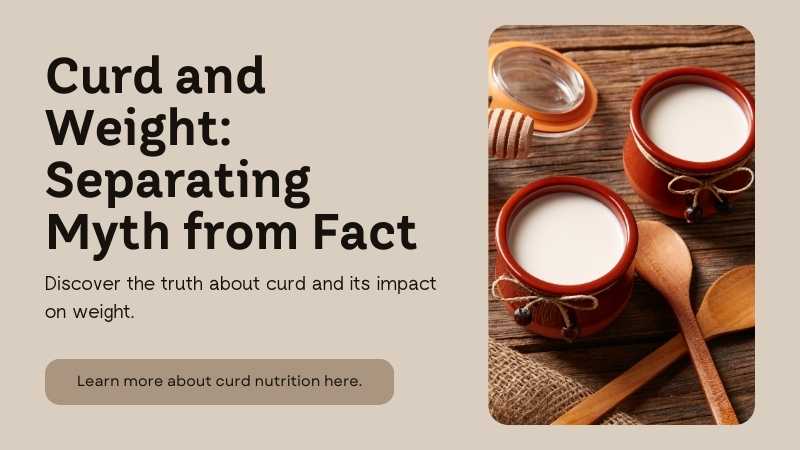
Indian meals are never complete unless you have a bowl of creamy Curd to cool down the effect of spices and masalas in your dishes. The humble “dahi” that sits at a corner of your thali has a creamy texture and distinct taste, making it a compelling addition to every cuisine. Curd is prepared through fermentation of boiled milk due to the action of probiotics like bifidobacteria and lactic acid bacteria, making it a powerhouse of nutrients. This dairy product is also called probiotic yoghurt [1] and is considered a healthy choice even for people having lactose intolerance [2]. So, will regular consumption of Curd lead to weight gain? Let’s explore its health benefits, constituents, and different types to make a better food choice.
Calorie and Nutrition Facts of Curd Per 100g
| Nutrient | Per 100g |
| Calories | 100 |
| Total Fat | 4.30g |
| Saturated Fat | 2.740g |
| Cholesterol | 17mg |
| Sodium | 364mg |
| Total Carbohydrate | 3.98g |
| Dietary Fiber | 0.0g |
| Sugars | 3.98g |
| Protein | 11.01g |
| Vitamin D | – |
| Calcium | 83mg |
| Iron | 0.05mg |
| Potassium | 141mg |
| Vitamin A | 25mcg |
| Vitamin C | 1.2mg |
For more detailed nutritional information about curd, visit FatSecret’s website: Calories in Curd and Nutrition Facts.
Does Eating Curd Can Lead To Weight Gain?
Curd is rich in probiotics, which makes it a gut-friendly food [3]. Consuming Curd with high protein content and fewer carbohydrates will not lead to weight gain, as it will help you build muscle mass and lose belly fat. However, like every food item, excess consumption of this fermented food is not advisable, as it can lead to constipation [4]. According to Ayurveda, as Curd takes time for digestion, eating it during dinner can affect your sleep cycle and might cause weight gain [5].
What is Curd, Yogurt, or Yoghurt?
Curd is a fermented dairy product derived from milk featuring milk solids and whey water loaded with proteins [6]. It is formed through the fermentation of milk where good bacteria like Streptococcus sp., Lactobacillus sp., and Lactococcus sp. perform the conversion of lactose into lactic acid, giving Curd a sour taste [7]. It has a semi-solid consistency, containing about 82% of water. Let’s take a look at the constituents of the Curd [8].
- Casein: The major ingredient of Curd helps it stay white even after fermenting.
- Protein: Curd has about 10% to 12% protein, which may slightly differ based on the curd variety you are using.
- Amino Acids are found in the Curd’s protein and are essential for your body’s functions.
- Carbohydrates: Curd is an excellent food for people trying to lose weight, as it contains just 3% carbohydrates due to lactose. Compared to milk, Curd has less lactose content, as it is utilized for producing organic acids during fermentation. It is also used to support lactic acid bacteria’s function.
- Fats: Curd has about 20% mono-unsaturated fatty acids, which are beneficial for your health, as they don’t get oxidized.
- Calcium: The presence of Calcium in Curd might be around 8% to 12%, which makes it beneficial for bone health.
- Vitamins: Curd is a source of essential vitamins for your body functions. It has 8% of vitamin B12 for DNA production, 8% of vitamin B2 or riboflavin to boost metabolism, and vitamin B5 or pantothenic acid to support body functions. It also contains traces of water-soluble vitamins B6, vitamin A, and E.
- Minerals: It has an abundant source of dietary minerals like phosphorus, zinc, magnesium, and potassium.
Differences between Various Types Of Curd
Though different types of Curd are prepared using various methods, they rely on the same principle of fermentation by adding healthy bacteria culture strains like L. bulgaricus and S. thermophiles. Some of the differences between the types of Curd are:
- Traditional Curd: This is the normal Curd that your mom makes at home by using full cream or low-fat warm cow milk to a spoonful of Curd to initiate fermentation. The Curd derived by this method is semi-solid with clear whey water setting above the thick Curd, as it is not strained. It has a slightly sour flavour.
- Greek Yogurt: Greek yoghurt is much creamier and thicker than its regular counterpart, as it is strained after fermenting. So, it has a high protein profile and very low lactose content. Sometimes, it can be very sour, as it is prepared like traditional Curd using live cultures and milk.
- Sheep Milk Curd: It is similar to Greek yoghurt, as it is creamier and has a thick consistency. Made by fermenting sheep milk, this Curd is not high in lactose content but has a natural, earthy flavour. The fat content is higher than traditional Curd.
- Goat Milk Curd: This type of Curd is slightly sweet and has an earthy flavour like sheep milk curd. Though not very thick like its Greek counterpart, this Curd is creamy and thick. It is perfect for people with lactose intolerance.
- Skyr/Icelandic Yogurt: The Skyr is gaining popularity among Greek yoghurt lovers, as it is strained four times. So, it is much thicker and creamy, as there are no traces of whey water. It has a milder tanginess than Greek yoghurt and has more protein content.
- Australian Curd: The consistency of this Curd can be described as not watery like regular Curd and not thick like Greek yoghurt. It is not strained like its Iceland or Greek version and is thick, as it is fermented using whole milk. It is flavourful with tangy and sweet notes.
- Vegan Curd: Curd prepared with vegan ingredients like coconut, peanut, cashew, almond, and soy by fermenting is called vegan Curd. These plant-based curd types are denser, creamier, sweet, tart and tangy.
Role of Curd in Weight Management
Consuming Curd regularly will help maintain your body weight within the healthy range, as it can keep you satiated and regulate your metabolism. The probiotics in Curd aid digestion, absorb nutrients in your food, and maintain better body metabolism. So, there will be a decrease in total calorie intake per day, essential for maintaining a healthy body weight.
Role of Curd in Weight Loss
Curd is considered a superfood for people trying to lose weight, as it is low in calories and protein. The protein content of Curd requires more time for digestion than carbohydrates and fats, so you will feel fuller, keeping hunger pangs away. Probiotics in Curd make it a gut-friendly food, as they facilitate fat breakdown and amp up your weight loss goals.
Role of Curd in Weight Gain
Though Curd doesn’t directly contribute to weight gain, it can help promote healthy weight gain. Its high protein content helps build muscle mass naturally. Curd improves body weight when added to a well-balanced diet with proteins, good fats, and nutrients in the right proportion. Trying unhealthy curd recipes with calorie-packed ingredients like sugar can cause significant weight gain.
Probiotics In Curd Affects Gut Health And Metabolism
The presence of beneficial bacteria like Bifidobacterium bifidum and Lactobacillus acidophilus makes Curd a probiotic-rich food. It helps in creating a perfect balance between the microorganisms in the gut while preventing the growth of toxic bacteria [9]. It promotes gut health by improving digestion [10]. It has fatty acids like butyrate that combat Bilophila wasdworthia bacteria [11] for preventing inflammatory bowel disease and irritable bowel syndrome [12] [13]. The probiotics in Curd facilitate healthy weight management by lowering body fat and regulating your appetite to create a positive impact on your body metabolism [14].
Factors Influencing Weight Gain
You are considered obese if your BMI is more than or equal to 30, and if you are over 25, you might be overweight. Several factors play a vital role in influencing your weight gain. It includes:
- Genetics: Factors like the calories you consume or calories you burn are influenced by your genes combination [15]. Genes [16] can make you obese by inducing hunger while some hormones might trigger food cravings, even if you have eaten already.
- Sedentary Lifestyle: If you have a busy work schedule, then incorporating time for workouts, good sleep, or having regular and healthy meals might not be possible. When you don’t burn calories and consume junk foods, it will lead to weight gain.
- Medications: If you are taking medications that contain steroids for chronic conditions like diabetes, then you might experience weight gain.
Benefits Of Curd For Weight Management
- Enhances Gut Health: The probiotics in Curd improve digestion, help absorb nutrition, and regulate waste disposal, thanks to the presence of Lactobacillus bulgaricus.
- Boosts Calcium: As Curd has rich dietary calcium content, it improves bone health and lowers cortisol release. This stress hormone can lead to weight gain by contributing to fat cell accumulation.
- Keeps You Full: Protein in Curd prevents you from consuming too many calories like snacks, as it keeps you satiated for longer hours.
- Regulates Blood Pressure and Sugar: Curd is rich in minerals like magnesium and potassium, which help regulate blood pressure and support insulin function.
- Prevent Fat Accumulation: Curd is rich in methionine, an irreplaceable amino acid that prevents fat from accumulating in the liver.
How To Add Curd Into A Weight-Conscious Diet
Create interesting recipes with Curd to make your meal time more fun.
- Snack: You can use Curd as the base for a creamy snack by topping it with your favourite fruit
- Breakfast: Prepare overnight oats with oatmeal, Curd, nuts, and fruits for a healthy breakfast
- Dip: Chop crunchy vegetables and enjoy a dip made with Curd, salt, pepper powder, fresh coriander, and mint leaves
- Drink: Have a refreshing midday drink by mixing Curd with water, pink salt, cumin, and ginger
References
- Masoumi, S. J., Mehrabani, D., Saberifiroozi, M., Fattahi, M. R., Moradi, F., & Najafi, M. (2021). The effect of yogurt fortified with Lactobacillus acidophilus and Bifidobacterium sp. Probiotic in patients with lactose intolerance. Food Science & Nutrition, 9(3), 1704-1711. https://doi.org/10.1002/fsn3.2145 – https://onlinelibrary.wiley.com/doi/full/10.1002/fsn3.2145
- Hadjimbei, E., Botsaris, G., & Chrysostomou, S. (2022). Beneficial Effects of Yoghurts and Probiotic Fermented Milks and Their Functional Food Potential. Foods, 11(17). https://doi.org/10.3390/foods11172691 – https://www.ncbi.nlm.nih.gov/pmc/articles/PMC9455928/
- Sharifi-Rad, J., Rodrigues, C. F., Stojanović-Radić, Z., Dimitrijević, M., Aleksić, A., Neffe-Skocińska, K., Zielińska, D., Kołożyn-Krajewska, D., Salehi, B., Prabu, S. M., Schutz, F., Docea, A. O., Martins, N., & Calina, D. (2020). Probiotics: Versatile Bioactive Components in Promoting Human Health. Medicina, 56(9). https://doi.org/10.3390/medicina56090433 – https://www.ncbi.nlm.nih.gov/pmc/articles/PMC7560221/
- Dan, T., Hu, H., Tian, J., He, B., Tai, J., & He, Y. (2023). Influence of Different Ratios of Lactobacillus delbrueckii subsp. Bulgaricus and Streptococcus thermophilus on Fermentation Characteristics of Yogurt. Molecules, 28(5). https://doi.org/10.3390/molecules28052123 – https://www.ncbi.nlm.nih.gov/pmc/articles/PMC10004190/
- Sabnis, M. (2012). Viruddha Ahara: A critical view. Ayu, 33(3), 332-336. https://doi.org/10.4103/0974-8520.108817 – https://www.ncbi.nlm.nih.gov/pmc/articles/PMC3665091/
- Fisberg, M., and Machado, R. History of yogurt and current patterns of consumption. Nutr Rev. (2015) 73 (suppl_1): 4-7. – https://www.hsph.harvard.edu/nutritionsource/food-features/yogurt/
- Sharma, C., Singh, B. P., Thakur, N., Gulati, S., Gupta, S., Mishra, S. K., & Panwar, H. (2017). Antibacterial effects of Lactobacillus isolates of curd and human milk origin against food-borne and human pathogens. 3 Biotech, 7(1). https://doi.org/10.1007/s13205-016-0591-7 – https://www.ncbi.nlm.nih.gov/pmc/articles/PMC5388649/
- El-Abbadi, N. H., Dao, M. C., & Meydani, S. N. (2014). Yogurt: Role in healthy and active aging. The American Journal of Clinical Nutrition, 99(5), 1263S. https://doi.org/10.3945/ajcn.113.073957 – https://www.ncbi.nlm.nih.gov/pmc/articles/PMC6410895/
- Lisko, D. J., Johnston, G. P., & Johnston, C. G. (2017). Effects of Dietary Yogurt on the Healthy Human Gastrointestinal (GI) Microbiome. Microorganisms, 5(1). https://doi.org/10.3390/microorganisms5010006 – https://www.ncbi.nlm.nih.gov/pmc/articles/PMC5374383/
- Npr.org – https://www.npr.org/2011/10/28/141800414/does-probiotic-yogurt-really-affect-digestion
- Natividad, J. M., Lamas, B., Pham, H. P., Michel, L., Rainteau, D., Bridonneau, C., Vlieg, H., Sovran, B., Chamignon, C., Planchais, J., Richard, M. L., Langella, P., Veiga, P., & Sokol, H. (2018). Bilophila wadsworthia aggravates high fat diet induced metabolic dysfunctions in mice. Nature Communications, 9. https://doi.org/10.1038/s41467-018-05249-7 – https://www.ncbi.nlm.nih.gov/pmc/articles/PMC6052103/
- Sharma, S., Kumar, S., Sajjad, S., & Sharma, S. (2023). Probiotics in Irritable Bowel Syndrome: A Review Article. Cureus, 15(3). https://doi.org/10.7759/cureus.36565 – https://www.ncbi.nlm.nih.gov/pmc/articles/PMC10122169/
- Zhu, L., Ying, N., Hao, L., Fu, A., Ding, Q., Cao, F., Ren, D., Han, Q., & Li, S. Probiotic yogurt regulates gut microbiota homeostasis and alleviates hepatic steatosis and liver injury induced by high-fat diet in golden hamsters. Food Science & Nutrition. https://doi.org/10.1002/fsn3.3930 – https://onlinelibrary.wiley.com/doi/full/10.1002/fsn3.3930
- Singh, R. P., Shadan, A., & Ma, Y. (2022). Biotechnological Applications of Probiotics: A Multifarious Weapon to Disease and Metabolic Abnormality. Probiotics and Antimicrobial Proteins, 14(6), 1184-1210. https://doi.org/10.1007/s12602-022-09992-8 – https://www.ncbi.nlm.nih.gov/pmc/articles/PMC9483357/
- Singh, R. K., Kumar, P., & Mahalingam, K. (2017). Molecular genetics of human obesity: A comprehensive review. Comptes Rendus Biologies, 340(2), 87-108. https://doi.org/10.1016/j.crvi.2016.11.007 – https://www.sciencedirect.com/science/article/pii/S1631069116301895
- Ekta Tirthani, Mina S. Said (Rochester General Hospital), Anis Rehman (District Endocrine/Sentara Northern Virginia Medical Center) – https://www.ncbi.nlm.nih.gov/books/NBK573068/
