

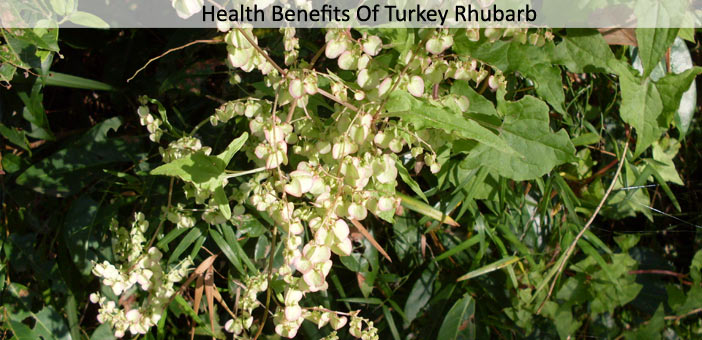
Turkey Rhubarb or Rheum palmatum, also known as the Himalayan rhubarb or Chinese Rhubarb, is a herb whose root has some potent medicinal properties. It is a flowering plant and belongs to Polygonaceae (knotweed family).
It has been an integral part of ancient Chinese folk medicine since time unknown. The roots of this plant contain certain potent biochemical compounds that could alleviate many health conditions. Read on to learn more about rhubarb roots and their benefits.
List of Top Benefits of Rhubarb Roots
1. Support for women
According to a double-blinded, randomized study, the results of which appeared in 2006, perimenopausal women who included Rhubarb in their diet for 12 weeks showed a significant decrease in the severity and frequency of menopausal symptoms. It also has blood-clotting properties that could help promote clotting and prevent excess bleeding during menopause. [1]
2. Cleanses Colon
Turkey rhubarb contains anthraquinones, a powerful purgative to eliminate harmful gut bacteria. The presence of the purgative compounds in this herb makes it an effective colon cleanser and has an astringent effect. It is also helpful in curing diarrhea.
Turkey rhubarb contains Anthraquinones (AQs), which have a laxative effect and are widely used in laxative preparations. This property can help in the treatment of constipation. [2]
In a Department of Intensive Care Unit study, Guangzhou efficacy of Turkey rhubarb was studied for sepsis treatment. It was found that the herb was effective in treating sepsis and reducing the injuries it caused in the liver, gastrointestinal tract, and lungs. It reduces inflammation and oxidative stress and thus maintains immune balance. [3]
Rhubarb also improves gastrointestinal function. It is primarily beneficial in patients with conditions like severe acute pancreatitis. [3]
3. Helps in weight Loss
Yet another benefit of Chinese Rhubarb is that it promotes weight loss. It can process the food as soon as it reaches the digestive system. Plus, its purgative properties promote effective elimination. Studies also suggest that rhubarb root might help accumulate fat in the intestine, aiding in weight loss. [4]
- Metabolism: It improves glucose and lipid metabolism and is crucial in managing obesity.
- Lowers Cholesterol: It helps in lowering Cholesterol, which is one of the important factors in weight management.
- Anti-adipogenic: In addition to adding fiber to your diet, phytochemicals in rhubarb act as cardioprotective, lipid-lowering, and anti-adipogenic effects.
4. Beneficial for various skin conditions
Turkey rhubarb has innately rich astringent and antibacterial properties. This makes it an effective solution for treating various skin conditions, including burns and sores. Since it can prevent bleeding, it could potentially cure various minor injuries.
5. Prevents renal failure
Another study suggests that Rhubarb root could be used efficiently to alleviate and thwart the risk associated with renal failure. It regulates metabolism and has anti-inflammatory, antibacterial, and diuretic properties, through which it protects the damaged kidney tissue. It further promotes protein synthesis and also helps in waste excretion. It is used to treat diabetic nephropathy and kidney diseases. The primary component in Rhubarb, emodin and rhein, has a protective effect on Kidney. [5]
Rhubarb helps in the healing of heat stroke-associated acute liver and kidney injury. It promotes the healing of organ injury. [6]
6. Beneficial for intestinal bleeding
Himalayan rhubarb has the power to control bleeding. Hence, it could effectively heal bleeding due to gastrointestinal conditions. It helps eliminate excessive bleeding, prevents bleeding, and reduces the need for a blood-clotting drug.
The study at Osaka University Graduate School of Medicine, Japan, found that Rhubarb effectively treated incompetent intestinal motility in patients suffering from systemic inflammatory response syndrome. It was suggested that Rhubarb can treat constipation and intestinal dysmotility in critically ill patients. [7]
7. Helps in lowering cholesterol levels
According to studies, the stalk fiber of Himalayan rhubarb could help lower the levels of low-density lipoprotein. Excess levels of bad Cholesterol negatively impact your health, including your heart. Hence, including these roots could help keep your heart safe and lower the risk of cardiovascular conditions like arteriosclerosis.
In a study done, it was seen that Rhubarb fiber reduces total Cholesterol by 8% and LDL cholesterol by 9%. It was found that HDL cholesterol levels remain unchanged. Once the researchers stopped the supplementation, total and LDL cholesterol levels returned to their initial values within a month. [8]
8. Beneficial for women during menstruation
Turkey rhubarb has innate anti-inflammatory properties that come from the presence of tannins and anthraquinones. Plus, it is also known to help control bleeding. Thus, women could use it during painful menstruation to ease the cramps and control excessive bleeding.
9. Helps in lowering the risk of cancer
The tannins and anthraquinones present in Turkey rhubarb have anti-inflammatory and antioxidant properties. These compounds scavenge the free radicals and lower the oxidative damage, reducing cancer risk. The anthraquinones also help kill the tumor cells, thus shedding some light on preventing metastasis. Emodin, a type of anthraquinone, induces a suicidal tendency in cancer cells and prevents cell cycle progression. Yet another anthraquinone, rhein, helps prevent the absorption of glucose by the cancer cells and modifies the membranes of these cells to kill them.
Aloe-emodin, a bioactive component of Rhubarb, has shown anticancer effects in laboratory studies. It was found that Aloe-emodin possesses anti-carcinogenic and anti-proliferative properties on human cancer cell lines. However, the effect was effective on specific cell types and not across all cell lines. [9]
Why should one not take Turkish Rhubarb in high quantity?
- Poisonous with excessive oral intake. [10]
- High oxalate content can bind metals, leading to:
- Iron deficiencies
- Anemia
- Electrolyte imbalances
- Not advised for individuals with kidney stones. [11]
- Not suitable for children under 12 years of age. [12]
- Not recommended for long-term use due to high oxalate content.
FAQs on Turkish Rhubarb
What makes Turkey Rhubarb so powerful?
Turkey rhubarb stores compounds like calcium oxalate, anthraquinones, tannins, and various fatty acids. The tannins and anthraquinones give them anti-inflammatory and antioxidant properties, making them a potential cure for cancer and other health conditions, including chronic constipation.
How to use Turkey Rhubarb?
Since the roots of these herbs are used for medicinal purposes, you can use them in the form of tea. However, it is also available in the form of tinctures and capsules.
What are the side effects of Turkish Rhubarb?
Even though Turkey rhubarb has a wide array of health benefits, it has some severe side effects that you should be aware of.
Extended use of this herb could lead to laxative dependency, vertigo, and even liver cirrhosis. Studies also suggest that people who have Crohn’s disease and colitis should avoid this herb. Pregnant women, lactating mothers, and children under 12 should also refrain from using this herb.
All is that ends well. As with other natural remedies, please check with your physician before using Turkey rhubarb. Take care and stay safe!
Key Facts About Turkey Rhubarb
- Scientific Name: Rumex crispus
- Family: Polygonaceae family
- Plant Appearance: Tall herb with thick root and wavy leaves
- Leaves: Large, green, and wavy-edged
- Flowers: Small, greenish-white clusters
- Root Use: Known for medicinal properties, especially as a laxative
- Nutrition: Contains tannins, anthraquinones, and oxalic acid
- Traditional Uses: Remedy for digestion, skin, and liver health
- Cultivation: Thrives in well-drained soil in temperate climates
- Propagation: Grown by seeds or root division
- Native Region: Originates from Europe and Asia, now found worldwide
- Risks: High oxalate content; toxic in large amounts
References
- Molekulare Zellphysiologie & Endokrinologie, Fachrichtung Biologie, Technische Universität Dresden, Zellescher Weg 20b, 01217 Dresden, Germany – https://www.ncbi.nlm.nih.gov/pmc/articles/PMC2837008/
- Department of Experimental and Clinical Medicine, University of Florence, Florence, Italy – https://www.ncbi.nlm.nih.gov/pmc/articles/PMC6979293/
- Department of Intensive Care Unit, Guangdong Provincial Hospital of Chinese Medicine, Guangzhou 510145, China – https://www.ncbi.nlm.nih.gov/pmc/articles/PMC4538976/
- Department of General Biochemistry, Faculty of Biology and Environmental Protection, University of Lodz, 90-236 Lodz, Poland – https://www.ncbi.nlm.nih.gov/pmc/articles/PMC9144273/
- College of Pharmacy and Shaanxi Collaborative Innovation Center of Chinese Medicinal Resources Industrialization, Shaanxi University of Chinese Medicine, Xianyang, 712046 China – https://www.ncbi.nlm.nih.gov/pmc/articles/PMC5745730/
- Clinical Laboratory, Affiliated Hospital of Jiangsu University, Zhenjiang, Jiangsu 212001, P.R. China – https://www.ncbi.nlm.nih.gov/pmc/articles/PMC6090376/
- Department of Traumatology and Acute Critical Medicine, Osaka University Graduate School of Medicine, Japan – https://www.ncbi.nlm.nih.gov/pmc/articles/PMC5849545/
- Department of Agricultural, Food and Nutritional Science, University of Alberta, Edmonton, Canada. – https://pubmed.ncbi.nlm.nih.gov/9430089/
- Department of Medicine, University of Miami Miller School of Medicine, Miami, Florida, United States – https://www.ncbi.nlm.nih.gov/pmc/articles/PMC6426255/
- Unit of Forensic Medicine and Toxicology, School of Medicine, University of Barcelona, Spain. – https://pubmed.ncbi.nlm.nih.gov/1288268/
- Washington State University, Spokane 99204-0399. – https://pubmed.ncbi.nlm.nih.gov/8335871/
- Book, Botanical safety handbook, M McGuffin – https://scholar.google.com

1 Comment
Just last week I had an reaction after 3 days of usesage. I should have asked my PCP before taking. I ended up in the hospital for 4 dayds. DX: liver injury. Check with your doctor before starting supplements.