

Excessive chewing of Betel leaves with tobacco can lead to cancer and other health problems.
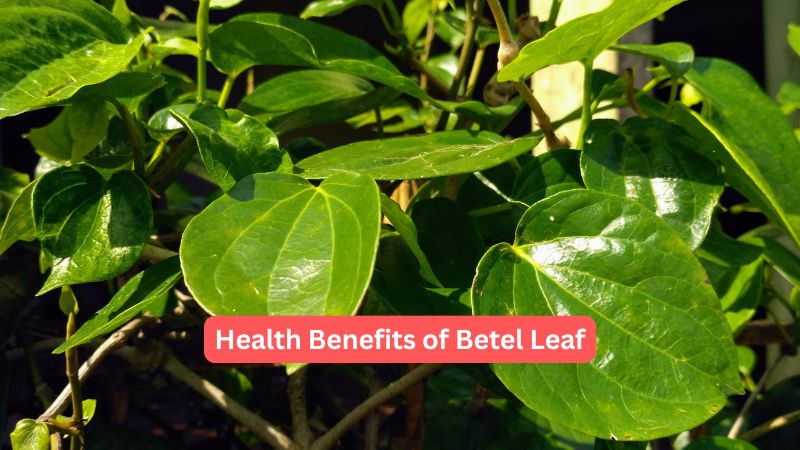
What is Betel Leaf?
Betel is a leaf of a vine in the Piperaceae family, which includes kava and pepper. It is a mild stimulant and has medicinal properties. It is a creeper and is evergreen. It has glossy, heart-shaped leaves and white catkins. It originated in Southeast Asia (Sri Lanka and India).
In Urdu, Bengali, and Hindi, the betel leaf is known as Paan. Being a creeper, it requires a pole or a compatible tree to grow. Fertile and high lands are best for cultivating betel leaves. Saline, waterlogged, and alkaline soils are good for growing this plant.
The betel plant is slender and aromatic, with roots at the nodes.
Ingredients in betel Leaf:
- It contains protein.(3.1%)
- Fat (0.8%)
- Minerals 2.3%
- Fiber. 2.3 %
- Carbohydrates (6.1%)
- Calcium
- Riboflavin
- Carotene
- Niacin
- Thiamine
- Vitamin
- Sugar
- Tannins
- Diastases
- Also contains essential oil
Health Benefits of Betel Leaf
Headache: To get relief from the problem, cut one of the big leaves into 2 parts. Gently warm the leaf over medium heat and place it on your temple. The compounds in it provide fast relief, and its aroma helps further.
Worm Infestation: To get relief from worm infestation, chew 1 leaf and spit out its juices. This helps remove small larvae from the mouth and reduce the problem.
Cough and Cold: The expectorant property of Betel leaf helps in getting rid of solid phlegm and expels it out. Chew 1-2 leaves 2-3 times a day to get relief. To make it more effective, use it with holy basil and honey. Soak the leaves in mustard oil, warm them, and apply them to the chest to relieve cough and make breathing easier.
Fungal Infestation: Patches due to fungal infection on the face, chest, and back could be healed using betel. Make a mixture of betel and onion and apply it on the affected areas.
Filariasis: Make a paste with 6-7 betel leaves and mix a small amount of rock salt to it. Take the paste with warm water in the morning for 1-2 weeks, and it should start relieving the problem.
Urination: In case of a problem during urination, a mixture of milk, sugar, and betel leaves could be used to get rid of the ailment.
Whitlow: Whitlow could be cured within 4-5 days. Make a paste of betel leaves and quicklime and apply it on the infected finger. Wrap a cloth around it. Remove the pack before going to bed. Repeat it for 4-5 days.
Other Remedies
- Cooling as well as analgesic properties
- Useful remedy for boils. Warm the leaf until soft, coat it with castor oil, and place it over the inflamed part. Replace it every few hours. After some applications,, the boil will rupture and empty the purulent matter. This application can be done at night and removed in the morning
- Helpful in treating nervous exhaustion as well as debility
- The juice of some betel leaves and a teaspoonful of honey can be used as a tonic. One can have it twice a day
- Betel leaves have diuretic properties
- The leaves are useful in pulmonary affections in old age and childhood
- Effective in treating sore throat
- Helpful in treating inflammation such as orchitis (inflammation of testes) and arthritis
- Leaves are useful in healing wounds. Apply the extracted juice of some leaves on the affected part. Then wrap the betel leaf over the wound and bandage it. The wound will heal within 2 days with the help of a single application
- Helps secretion of milk in breasts during lactation. One has to apply leaves smeared with oil on the breast
- Relieves one of ear aches
- Some components prevalent in betel leaves may help in diabetes
Betel leaves are very popular in the East. Many chew the leaves. Many in the East chew them after a meal.
Other Names
Hindi: Pan
Telugu: Thamalapaku
Kannada: Vilyadele
Tamil: Vathalaikkodi
Malayalam: Vetulakkoli
Sanskrit: Thambulavalli
What Science Says About Betel Leaf
Betel leaf, or Piper betle, has a long history in traditional medicine across South and Southeast Asia. Modern lab studies back some of this.
- The leaf is rich in phenolic compounds like eugenol and chavicol. These give it antioxidant activity. (BMC Complementary Medicine)
- Betel leaf extract and its essential oil can slow the growth of some bacteria and fungi. (PubMed review)
- Studies also point to anti-inflammatory effects.
One point matters. Most of this work is from lab and animal studies. Strong human evidence is still limited. So betel leaf should not replace a doctor’s treatment for any serious health issue.
Betel Leaf vs Betel Quid (Paan): Know the Difference
This is the key thing to understand. The plain leaf is not the same as the paan most people chew.
Paan, also called betel quid, wraps the leaf around areca nut (supari) and slaked lime (chuna). Many add tobacco too. That mix is where the real danger lies. The IARC classifies betel quid and areca nut chewing as cancer-causing. Regular use is linked to oral cancer and to oral submucous fibrosis, a stiffening of the mouth. (IARC, 2004)
| Feature | Plain Betel Leaf | Betel Quid / Paan |
|---|---|---|
| Contents | Just the leaf | Leaf plus areca nut and lime, often tobacco |
| Research view | Some antioxidant and antimicrobial value | Classed as cancer-causing by IARC |
| Main risk | Low on its own | Oral cancer, oral submucous fibrosis |
| Habit-forming | No | Yes, areca nut is addictive |
Who Should Be Careful
A few groups should take extra care.
- Anyone chewing paan with areca nut or tobacco should think about stopping.
- See a dentist or doctor if you notice mouth burning, white patches, or trouble opening your mouth wide.
- Pregnant women should avoid areca nut and tobacco quids.
- Do not use betel leaf in place of prescribed medicine for a serious illness.
Frequently Asked Questions
Is betel leaf good for health?
The plain leaf has a long traditional use. It has some lab-backed antioxidant and antimicrobial value. Human evidence is still limited. It is best seen as a supportive item, not a cure.
Is chewing paan safe?
The plain leaf on its own is low risk. Paan with areca nut and tobacco is not. That mix is strongly linked to oral cancer.
Does betel leaf cause cancer?
The leaf alone is not the main concern. It is the betel quid with areca nut and tobacco that IARC classifies as cancer-causing.
What is betel quid made of?
It is a betel leaf wrapped around areca nut and slaked lime. Many people also add tobacco and flavorings.
Is areca nut (supari) the same as betel leaf?
No. Areca nut is the seed of a different plant. It is the addictive and harmful part of paan, not the leaf itself.
References
- Karak S, et al. Flavored Food Additives on the Leaves of Piper betle L.: A Human Health Perspective. PubMed
- BMC Complementary Medicine and Therapies. Antioxidant and cytoprotective activities of Piper betle, Areca catechu and betel quid
- Piper Betel Linn (Betel Vine): a review of its medicinal properties. Asian Pacific Journal of Cancer Prevention
- IARC Monographs on the Evaluation of Carcinogenic Risks to Humans, Vol. 85: Betel-quid and Areca-nut Chewing (2004).

1 Comment
Betel leaf has lots of health benefits especially in asthma and bronchitis patients if I am not wrong. But the point we are missing here is how people use betel leaves with tobacco which makes this as one of the killer leaves. When the same betel leaves are taken in the form of pan with jarda or tobacco, it becomes a source of cancer. Correct me if I am wrong. I know that there is a good and a bad side of everything but I hate betel leaves for the way it is used in Indian sub continent.