

The kola nut – also spelled cola nut – is the caffeine-rich seed of the West African kola fruit (Cola acuminata and Cola nitida). This “African nut” is chewed for energy, used in traditional medicine, and famously gave cola drinks their name.
Modern beverages we consume daily, such as colas and sodas, contain kola nut as a key ingredient. The versatile kola nut’s name is ‘cola’ for popular beverages containing caffeine. Kola nut is also used in alternative medicine and has become quite popular recently. Some African cultures also chew it traditionally, and it tastes quite bitter. However, it leaves a pleasant aftertaste and smells like the popular spice nutmeg. Let’s know more about the kola nut in detail.
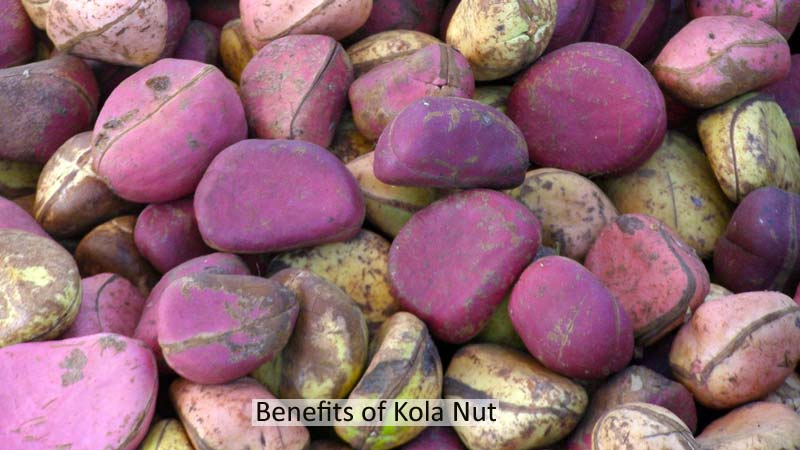
Kola Nut at a Glance
| Detail | Description |
|---|---|
| Common names | Kola nut, cola nut, kola fruit, African nut, “Obi” (Yoruba) |
| Botanical name | Cola acuminata and Cola nitida (family Malvaceae) |
| Part used | The seed (nut) of the kola fruit |
| Native to | Tropical rainforests of West Africa |
| Main compound | Caffeine (plus theobromine, tannins) |
| Caffeine strength | One nut = 2 large cups of coffee |
| Colour | Varies by variety – white, pink or red kola nuts |
| Taste | It is bitter when fresh, but, milder and nutmeg-like when dried |
| FDA status | Recognized As Safe (GRAS) as a natural flavouring |
Key Compounds in Kola Nut
| Compound | Type | Role |
|---|---|---|
| Caffeine (~2.8%) | Stimulant alkaloid | Energy, alertness, metabolism boost |
| Theobromine (~0.05%) | Stimulant alkaloid | Mild stimulant, found in cocoa |
| Tannins | Polyphenol | Astringent: affects the stomach |
| Catechins (d-catechin, l-epicatechin) | Flavonoid | Antioxidant activity |
| Phenolics and flavonoids | Antioxidant | Help fight free radicals |
| Phytoestrogens and phytoandrogens | Plant hormones | Behind some traditional men/women uses |
Source: Bioactive compounds in Cola nitida, NCBI.
List of 10 Popular health benefits of Kola Nut
Kola nut offers various health benefits, all thanks to its high caffeine content, phytoestrogens, and phytoandrogens. While some of the benefits may be scientifically proven, most are rooted in traditional folklore, and modern research on the kola nut specifically remains limited. Much of what people credit to the kola nut is really the effect of its caffeine.
1. Consumption increases the circulation of oxygen
We all love our cups of caffeine when we want some instant energy! Since kola nuts have high caffeine content, it increases oxygen circulation due to their stimulating effect. This also helps regulate the heart rate. For the same reason, it is used in many medicines and as a cognitive booster, energizing the brain and increasing concentration.
Oxygen is circulated to all body parts, including the brain, which helps it to focus better. The increased blood flow also helps injuries heal faster. Plus, you feel delighted – the caffeine effect.
2. Digestive benefits of kola nut
In Africa, kola nuts are often chewed after meals to relieve digestive issues. Kola nuts help the gastrointestinal system by breaking down food, providing energy, and preventing pathogenic microorganisms in the stomach. If you have chronic constipation, kola nuts can help relieve it.
Just chew on a few kola nuts after eating, and watch gastro problems like bloating, cramping, and constipation go away. That said, the evidence here is mostly traditional. If you already deal with acid reflux, gastritis, or IBS, kola nut can actually make things worse because the caffeine and tannins stimulate stomach acid. Go easy at first and see how your gut responds.
3. Boosting the immune system due to anti-bacterial properties
You may have come across kola nut extracts at many pharmacies. The reason is that the kola nuts are believed to contain compounds that can fight many bacterial infections. Kola nuts are also antioxidant-rich and help your body get rid of free radicals. Your resistance to bacterial and respiratory issues increases, and you fall sick less often.
Newer lab studies have also looked at kola nut extract against oral bacteria, and the results are interesting;: the extract showed some activity against the microbes that cause cavities and gum issues. It’s still early-stage research done in petri dishes, not human trials, so don’t trade your toothbrush for a kola nut just yet.
4. Aids in losing weight
Kola nut is often suggested for people who want to lose weight but have a slow metabolism(1). The caffeine in kola nuts acts as a stimulant to the central nervous system, speeding up metabolic processes. Caffeine has been shown in research to give metabolism a modest boost and slightly increase the calories you burn at rest, which, over time, can support a weight-loss plan that already includes sensible eating and movement.
But it’s worth being honest here, caffeine alone is not a fat-burning miracle. If you’re relying on kola nut or any caffeine source to do the heavy lifting, you’ll likely be disappointed. It can also backfire if not taken in moderation, so don’t treat it as a shortcut.
5. Helps to treat respiratory disorders
Caffeine is considered a warm beverage and can thus effectively treat respiratory diseases such as asthma, coughs, influenza, and bronchitis. Have some kola nuts to help dissolve the mucus; once it is out of the body, you will feel relieved. The idea is to loosen mucus in the lungs by thinning it so you can breathe without discomfort.
That said, kola nut is not a replacement for an asthma inhaler or prescribed medication. If you have a diagnosed respiratory condition, treat this as supportive at best and always stick with what your doctor has put you on.
6. Recommended for pain in the knees
When taken in moderate amounts, kola nut is sometimes used in traditional remedies for joint discomfort, and a few animal studies have shown that kola nut extract has anti-inflammatory and pain-relieving effects. Whether that meaningfully translates into easing human knee pain remains unclear, since we don’t yet have solid human trials.
If you’re dealing with persistent joint pain or suspect osteoarthritis, kola nut is fine as a supportive treatment. However, it shouldn’t replace proper care, physiotherapy, and weight management. It can not be a replacement for modern options like topical NSAIDs or guided strengthening exercises. These are better supported by evidence. People should always give them first preference.
7. Helps in prostate cancer
Kola nut exhibits antioxidant properties, and there has been some early interest in whether its compounds could play a role in cancer research. A 2012 study found that a hexane extract from kola seed (Cola acuminata) showed promising results in laboratory settings, with the potential to inhibit or kill certain breast and prostate cancer cells in culture. (Source)
This is important to keep in perspective: these were cells in a lab, not patients. There is no clinical evidence in humans that eating kola nut treats, prevents, or shrinks prostate cancer or any other cancer. If you or someone in the family is dealing with a diagnosis, kola nut is not a treatment. Modern prostate cancer care has come a long way, and oncologists are the right people to talk to.
8. Natural therapy for cold and related infections
Caffeine has some properties similar to older bronchodilator drugs like theophylline and can have a mild airway-opening effect. Limited, calculated doses of kola nuts may help relieve congestion during a cold. However, excess caffeine in the body may cause sickness, so don’t lean on it too hard. Again, do take your doctor’s advice if symptoms hang on.
9. Kola nut for migraine
Caffeine has a complicated relationship with headaches. In small, occasional doses, it can actually ease a tension headache or boost the effect of pain relievers like aspirin or paracetamol, which is exactly why many over-the-counter migraine medicines still combine caffeine with painkillers.(3)
There is, of course, a flip side, and let’s explore it further. Regular high caffeine intake can also trigger migraines. Suddenly stopping it after daily use can cause rebound headaches. A 2023 analysis of US adults found that people consuming 400 mg or more of caffeine a day had a noticeably higher prevalence of severe headaches and migraines. (Source) A small amount of kola nut might help with headaches. However, using it daily can cause more harm than good if you’re prone to migraines.
10. Natural diuretic
Caffeine is also a mild natural diuretic, so the consumption of kola nuts can help you expel excess water from the body. Kola nuts have been studied for their diuretic effects in animal models(4), and the methanolic extract of kola nut did show diuretic activity in those studies. Worth noting, though, if you actually have a kidney condition, hypertension, or liver issues, self-treating with kola nut is not a great idea. These are conditions for which modern medicines exist, and caffeine can interact with them.
Kola Nut Benefits for Men and Women
Kola nut benefits for men
Kola nut has long been used in West Africa as an aphrodisiac and a natural energy and stamina booster(source). The caffeine gives a quick lift in alertness and drive, and the nut’s phytoandrogens are one reason it is traditionally linked with “manhood” and vitality. It is also used as an appetite suppressant. Keep in mind these uses are mostly traditional – there are no strong human trials proving kola nut improves male fertility or performance, and too much caffeine can do the opposite by raising anxiety and disturbing sleep.
Kola nut benefits for women
For women, kola nut is valued mainly for its energy, focus, and appetite-suppressing effect, and it contains phytoestrogens (plant compounds similar to estrogen). As with men, the evidence is largely traditional rather than clinical. One important caution: kola nut is high in caffeine, and health bodies advise pregnant and breastfeeding women to keep caffeine low (under about 200 mg a day)(source). Since a single nut can pass that limit, it is safest for women who are pregnant or nursing to avoid it.
Comparison of Kola Nut with Other Stimulants
| Stimulant | Primary Compound | Common Uses | Caffeine Level | Origin |
|---|---|---|---|---|
| Kola Nut | Caffeine, Theobromine | Energy booster, traditional medicine | High | West Africa |
| Coffee | Caffeine | Morning beverage, mental alertness | High | Worldwide (Ethiopia origin) |
| Tea | Caffeine, Theanine | Relaxation, focus | Moderate | East Asia |
| Guarana | Caffeine | Energy drinks, weight loss supplements | Very high | South America |
| Yerba Mate | Caffeine, Theobromine | Traditional South American drink, energy booster | Moderate | South America |
| Ginseng | Ginsenosides | Boosts energy, improves cognitive function | None (caffeine-free) | East Asia |
| Green Tea Extract | Caffeine, Catechins | Weight loss, antioxidant properties | Moderate | East Asia |
About Kola Nut and its Industrial Uses
What is Kola Nut?
The seeds of the kola fruit of Cola acuminata and Cola nitida trees, native to tropical rainforests of western Africa, are desirable as food, flavoring agents, and an element in alternative medicine. The fruit resembles a star in ape and grows on trees that are 40 to 60 feet tall. Each fruit contains 5-6 kola nuts, each packed with caffeine. Many chew it to get the caffeine effect – the equivalent of 2 large cups of American coffee in one nut.
It is a cash crop for African farmers, and you would find small piles of kola nuts at every busy place on the continent. Nigeria, the Ivory Coast, Cameroon, Ghana, and Sierra Leone together account for nearly all of the world’s kola nut supply, with Nigeria alone accounting for over half. Outside Africa, you’re far more likely to come across it as an extract, capsule, or tea than as a fresh nut. Health food stores and online sellers are usually the easiest sources.
Industrial Uses of kola nut
Due to its high caffeine content, kola nut extract has historically been used as a flavoring agent in colas like Coca-Cola and Pepsi, though most modern commercial sodas use synthetic flavorings and added caffeine instead, with little to no actual kola nut. The U.S. Food and Drug Administration (FDA)(5) lists kola nut as Generally Recognized As Safe (GRAS) and approves it as a natural flavoring agent for food and beverages.
Warning and side effects of kola nuts
Kola nuts come packed with high amounts of caffeine, and unlike commercial beverages, where caffeine content is printed on the label, the dose in a single kola nut can vary quite a bit. It doesn’t trigger a typical tree-nut allergy since it’s a fruit seed, but the caffeine itself is what to watch out for. It is not suited for people who-
- Suffer from hypertension – people who have hypertension and related issues should limit caffeine intake, since it can increase heart rate and cause a temporary spike in blood pressure.
- Struggle with sleep issues – If you suffer from insomnia or frequently face trouble sleeping, it is best to avoid kola nuts as they can aggravate the problem.
- Have a weak immune system or sensitive stomach – Caffeine and tannins in kola nut can cause diarrhea, nausea, or stomach upset, especially in people who are already vulnerable.
- Have a sensitivity to caffeine – You may experience involuntary shaking of hands and bouts of anxiety if you are sensitive to caffeine and related products. Maintain distance from kola nuts.
- Are pregnant or breastfeeding – Current guidance from most obstetric bodies is to keep caffeine under 200 mg per day during pregnancy. Since one kola nut can easily push you past that, it’s safer to avoid it altogether while pregnant or nursing.
- Are on medication – Caffeine can interact with stimulants, certain antidepressants, thyroid medication, blood thinners, and some heart drugs. If you’re on regular medication, run it past your doctor first.
- Nausea – Due to overconsumption one could have stomach upset. Increased stomach acid production can also cause discomfort or pain.
The FDA still cites 400 milligrams of caffeine per day as the upper limit for healthy adults, roughly two to three cups of brewed coffee, but sensitivity varies a lot from person to person. Kola nut can be useful in moderation, but it’s not a substitute for proper medical care, and the larger the dose, the greater the risk of side effects.
Kola nut FAQs
What are the side effects of kola nut?
The caffeine in kola nut may have various side effects, depending on the person. Some people experience insomnia, anxiety, or mood swings, while others develop headaches, increased heart rate, stomach irritation, vomiting, and tingling sensations. Most of these come from using it in large amounts or for extended periods. Very high caffeine doses have been linked, in rare cases, to seizures and dangerous heart rhythm changes. Talk to your doctor before you start using it as a supplement, and stop if you notice any reaction that worries you.
How is the kola nut traditionally used for?
The kola nut is traditionally used in cultural and ceremonial settings across West Africa, where it’s shared as a sign of hospitality, used in welcome rituals, weddings, and important community gatherings. In folk belief it’s been associated with wisdom, strength, and good health, and it’s also been used traditionally as an appetite suppressant and energy booster. You’ll occasionally hear bigger folk claims attached to it, curing serious diseases, bringing luck, and so on, but those are cultural beliefs, not medical facts.
Is Kolanut good for diabetes?
Kola nut is a West African seed (not Indian, despite some online confusion) that has attracted interest in early diabetes research. Lab studies suggest that compounds in kola nut may inhibit α-amylase and α-glucosidase, two enzymes involved in breaking down carbohydrates, which in theory could help slow blood sugar spikes (research). A 2019 animal study also found that the hot-water extract of kola nut lowered blood glucose and improved cholesterol markers in diabetic rats.
These are early signals. However, they are still mostly test-tube and animal results. Kola nut is not a proven treatment for type 2 diabetes in humans. It should not replace prescribed medication. If you’re managing diabetes, discuss kola nut with your doctor before adding it. Never use it as a home cure.
Is kola nut the same as cola nut?
Yes. Kola nut and cola nut are two spellings of the same seed from the West African kola tree (Cola acuminata and Cola nitida). The word “cola” in soft drinks comes from this nut. Some people also call it kola fruit or African nut.
What is bitter kola, and is it the same as kola nut?
No, they are different. Bitter kola (Garcinia kola) is a separate West African seed from a different plant. True kola nut comes from the Cola tree and is high in caffeine, while bitter kola is a smaller, very bitter seed used in its own traditional remedies. People often mix up the two names, but they are not the same thing.
Does kola nut keep you awake?
Yes. Kola nut is high in caffeine – a single nut can hold more caffeine than two large cups of coffee(source). That makes it a strong natural stimulant that can keep you alert. For the same reason, avoid it in the evening or if you have trouble sleeping.
How do you make kola nut tea?
To make kola nut tea, break or grind a small piece of dried kola nut, add it to hot water, and let it steep for about 5 to 10 minutes. Strain and drink it warm. You can add honey, ginger or lemon to soften the bitter taste. Because it is high in caffeine, keep the amount small and avoid it late in the day.
