

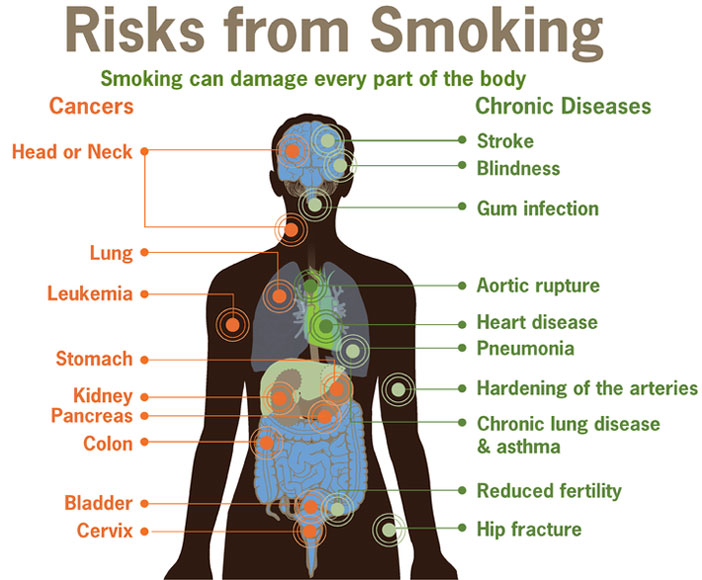
Smoking can cause much damage to one’s health. People smoke to relieve daily life tensions and worries. Initially, they may start with a cigarette or two, but eventually, they become addicted to it and become chain smokers.
Anti-smoking campaigns have been held to highlight the harmful effects of smoking on one’s health. In several countries, smoking is banned in public places. How does smoking affect us? Let us have a look.
The Main Diseases Caused by Smoking (Quick Answer)
If you want the short version, the four main diseases linked to smoking are lung cancer, chronic obstructive pulmonary disease (COPD), chronic bronchitis, and coronary heart disease. Three of these affect the lungs, and one affects the heart and blood vessels. The three biggest killers are lung cancer, COPD, and heart disease.
Smoking harms the body through more than one substance. The table below shows the main diseases and the part of smoke behind each one.
| Disease | Body Part | Main Substance Behind It |
|---|---|---|
| Lung cancer | Lungs | Tar and carcinogens |
| COPD (emphysema) | Lungs | Tar and irritant gases |
| Chronic bronchitis | Lungs and airways | Tar and irritant gases |
| Coronary heart disease | Heart and blood vessels | Nicotine and carbon monoxide |
What Diseases Does Nicotine Cause?
People often blame nicotine for everything, but the picture is more mixed. Nicotine is the addictive part of tobacco. On its own, it raises your blood pressure and heart rate and strains the heart and blood vessels. This adds to the risk of high blood pressure, heart disease, and stroke.
Most of the cancer and lung damage comes from the other parts of smoke, like tar, carcinogens, and carbon monoxide, not nicotine itself. That is why nicotine replacement products like patches and gum are far safer than cigarettes. They give nicotine without the burning smoke.
Diseases Caused by Smoking
1. Cardiovascular disease
The heart gets damaged by smoking, and blood circulation is also affected. Nicotine and the other chemicals in cigarette smoke impair the oxygen supply to various parts of the body. Tobacco raises cholesterol levels in the blood. Cholesterol and other fats tend to get deposited in arteries, hardening them over time. The arteries become narrow, blocked, and rigid. Due to this, blood clots can form, causing strokes and heart attacks. The common cardiovascular diseases a smoker suffers from are:
- Coronary thrombosis.
- Coronary heart disease.
- Peripheral artery disease (blockage in the legs).
- Cerebrovascular diseases like stroke.
- Abdominal aortic aneurysm.
Smoking increases the risk of heart and blood vessel diseases like CHD, stroke, and PAD. It causes blood clots and worsens fatty deposits in arteries. The more you smoke, the higher the risk. Even secondhand exposure is harmful. Low-tar and “light” cigarettes are also not safer, despite older marketing claims. Quitting smoking completely is the only reliable way to lower the risk, and the heart benefits actually start within days of the last cigarette. (1)
2. Chronic Obstructive Pulmonary Disease (COPD)
This disease affects breathing. One faces breathing difficulties. Associated health problems include chronic bronchitis and emphysema. The latter refers to breathlessness as the air sacs get damaged. In chronic bronchitis, one experiences frequent coughing with a lot of mucus. Smoking causes around 80% of COPD cases. It also slows lung function, resulting in breathlessness.
Smoking is the primary cause of COPD, one of the fastest-growing global health issues. Lifelong smokers have around a 50% chance of developing COPD. Quitting smoking can cut the risk in half and slow the disease’s progression even after diagnosis. Approved options to help people stop smoking include nicotine replacement therapy (gum, patches, lozenges, inhalers, nasal spray), bupropion, and varenicline. Behavioral counseling, national quit lines, and quit-smoking apps also help, and combining medication with counseling roughly doubles the chances of quitting compared to going it alone. (2)
3. Cancer
The carcinogens that are present in tobacco cause cancer of the lungs, mouth, gullet, and throat. Nearly 90% of lung cancer cases are due to smoking. One can also develop cancer of the bladder, pancreas, kidney, liver, stomach, colon and rectum, and esophagus. Females are at risk of developing cervical cancer, and smokers also have a higher risk of acute myeloid leukemia. The CDC and WHO link smoking to at least 16 different types of cancer.
Smoking exposes the body to harmful chemicals that lead to cancer. These chemicals can be detected in smokers’ urine and create damaging compounds called DNA adducts inside cells. Some inherited gene variants make certain smokers even more vulnerable to lung cancer. Smoking causes DNA damage and mutations in genes such as TP53 and KRAS. This increases the risk of lung cancer. Smoking also affects key tumor-suppressing genes. Chemicals in smoke help damaged cells survive, and people are more likely to get cancer. Quitting smoking today is the only proven way to reduce this risk. (3)
4. Sexual problems
Here is yet another reason to get scared and plan to quit smoking. Research has long established that smoking is one of the causes of erectile dysfunction. The main reason is plaque buildup in the arteries, which reduces blood flow to the vessels supplying the genitals. This causes several problems related to the circulatory system, and erectile dysfunction is one of them. Smoking has also been linked to reduced fertility in both men and women, lower sperm count and quality in men, and earlier menopause in women.
5. High blood pressure
Nicotine is the main culprit when you smoke. It is a primary cause of raised blood pressure and a faster heart rate. It also hardens arterial walls, narrows them, and obstructs blood flow. Because of this, blood is more likely to clot, too. All these make the perfect platform for a stroke or a heart attack. Think twice before you light up another cigarette.
Smoking raises blood pressure and heart rate immediately, primarily due to the nicotine in tobacco. Blood pressure rises even before stress hormones like catecholamines climb. Smoking can also reduce the effectiveness of some blood pressure-lowering medications. Quitting smoking, on the other hand, lowers blood pressure and reduces cardiovascular risk over time. Some people may notice a temporary rise in BP during the first weeks of nicotine withdrawal as the body adjusts, but the longer-term benefit is a clear improvement. People with high BP should keep taking their medications as prescribed while quitting, and their doctor may need to adjust doses once the quit has stabilized. (4)
6. Acid taste in the mouth
Long-term smokers commonly report this. The sense of taste becomes dulled or distorted, which is the main cause of an acidic or salty taste in the mouth. Smoking also dries out the mouth and increases acid reflux, both of which add to the problem. The good news is that taste tends to recover, often within weeks to a few months of quitting, as the taste buds and oral lining heal. Heavy smokers can also develop mouth ulcers and persistent bad breath.
7. Asthma gets worse
If a person has asthma, the smoke of irritating tobacco irritates the lining of the airways, which are moist and sticks to it. This could easily cause an asthma attack. It can also damage the cilia in the airways, which primarily clear dust and mucus. Since the cilia are damaged, harmful substances accumulate on the airway walls, due to severe asthma attacks. People with asthma who currently smoke are more affected than those who quit. Doctors routinely advise asthma patients to quit smoking for better long-term lung health.
Smoking worsens asthma symptoms and lung function. It also makes asthma medication less effective, particularly inhaled corticosteroids, which means smokers often need higher doses for the same effect. Smokers have more asthma flare-ups and worse lung function than those who never smoked or quit smoking. Quitting smoking noticeably improves asthma control within weeks. (5)
8. Early aging
Smoking reduces the blood supply to the skin, leading to earlier skin aging. The skin becomes pale and dry, and wrinkles form faster, especially around the eyes and mouth.
Smoking accelerates skin aging by disrupting collagen production and increasing the breakdown of the skin’s structural proteins. It also disrupts skin metabolism and increases reactive oxygen species levels, both of which contribute to premature aging. Quitting smoking strongly motivates many people who are conscious of their appearance, and many notice a clearer, healthier-looking complexion within months of stopping. (6)
9. Macular degeneration
This refers to the gradual loss of central vision. Smoking causes such health conditions. Smokers are also at higher risk of developing cataracts.
Smoking is a confirmed risk factor for the development and progression of Age-Related Macular Degeneration (AMD), a leading cause of irreversible vision loss. It contributes through vascular inflammation and oxidative damage. Quitting smoking reduces the risk steadily, and within around 10 to 20 years of quitting, the risk drops close to that of someone who has never smoked. (7)
10. Oral health
Smoking causes bad breath and harms the gums. It stains the teeth and gums. It can also cause loose teeth and tooth loss due to gum disease. Smoking negatively affects oral health and also slows healing after dental procedures like extractions and implants. (8)
11. Pregnancy problems
Smoking is bad for pregnant women as it can affect the child’s neurological development during the fetal stage. One can experience pregnancy complications such as placental abruption (premature detachment of the placenta), bleeding, ectopic pregnancy, and premature delivery. The risk of miscarriage and stillbirth is also higher. Babies can be born with congenital defects like cleft lip and palate, low birth weight, or with heart defects.
Smoking during pregnancy (SDP) significantly increases the risk of health issues for both mother and infant. The risks include sudden infant death syndrome (SIDS), childhood asthma, stillbirth, low birth weight, and later childhood obesity. The risks are tied to the number of cigarettes a pregnant woman consumes, and quitting at any point in pregnancy reduces them. (9)
12. Kidney failure
As smoking raises blood pressure and reduces blood flow to the kidneys, angiotensin II production increases, which causes hardening of the renal arteries. Smoking also narrows the blood vessels in the kidneys. As a result, kidney function declines over time.
Smoking significantly increases the risk of developing chronic kidney disease (CKD). It is more dangerous for people already dealing with hypertensive or diabetic nephropathy. The risk is higher among current smokers compared to non-smokers, and quitting slows the progression of kidney decline. (10)
13. Impotence
Forget reaching for Viagra first. Quitting smoking can ease this problem in many men, especially if you are in your 30s or 40s and have been smoking for a while. Remember, it can take some weeks to months before you notice the improvement, and other lifestyle factors like weight, alcohol, sleep, and exercise matter too.
Smoking increases the risk of erectile dysfunction (ED). It happens due to vascular changes, mainly by depleting nitric oxide levels in the blood vessels that supply the penis. Quitting smoking improves erectile function in controlled trials, with the biggest benefits seen in younger men with shorter smoking histories. Overall, smokers face a higher risk of ED regardless of age or other health conditions. (11)

Other conditions caused by smoking are-
- Diabetic retinopathy – smokers with diabetes are at higher risk.
- Type 2 diabetes (smoking increases the risk by 30-40 percent and makes blood sugar control harder for those who already have it).
- Tuberculosis.
- Crohn’s disease.
- Multiple sclerosis (smoking worsens disease progression).
- Chest infections, including more frequent pneumonia.
- Higher risk of sudden infant death syndrome (SIDS) for babies of smoking mothers or those exposed to secondhand smoke.
- Rheumatoid arthritis and autoimmune conditions worsening.
- Cognitive decline with a long-term risk of dementia.
- Slower wound healing
- Higher risk of surgical complications
Smoking has severe repercussions for one’s health. Efforts are on to help smokers quit the habit. Passive smoking is also hazardous, and to protect non-smokers, smoking has been banned in public places in many countries.
Vapes and e-cigarettes are marketed as a safer alternative. They do deliver fewer combustion-related toxins than regular cigarettes, but they are not harmless. Vape aerosols contain high doses of nicotine. It also contains ultrafine particles, flavoring chemicals like diacetyl, linked to “popcorn lung,” and heavy metals from the heating coil. Young people who vape are more likely to start smoking traditional cigarettes later. For someone who has never smoked, picking up vaping is a bad idea.
Conclusion
Smoking significantly harms nearly every organ in the body, leading to a wide range of diseases. It is a leading cause of cancer, heart disease, stroke, lung diseases, and type 2 diabetes. Globally, tobacco use is responsible for over 8 million deaths each year, according to the WHO, including around 1.3 million non-smokers who die from secondhand smoke exposure. This makes the case for smoking cessation initiatives, accessible quit support, and public health policies as critical as ever. The vast health implications underscore the need for continued awareness and action to reduce smoking rates and prevent the associated health risks. The encouraging news is that quitting works at any age, and the body begins repairing itself within hours of the last cigarette.
Diseases Caused by Smoking FAQs
What are the 4 main diseases caused by smoking?
The four main ones are lung cancer, COPD, chronic bronchitis, and coronary heart disease. Three of them affect the lungs, and one affects the heart and blood vessels.
What are the 3 main diseases caused by smoking?
The three biggest are lung cancer, COPD, and heart disease. These cause the most deaths among smokers worldwide.
What diseases does nicotine cause?
Nicotine is the addictive part of smoke. It raises blood pressure and heart rate and adds to heart and blood vessel disease. The cancers and most lung damage come from tar and other chemicals, not nicotine.
What is the lung disease caused by smoking called?
The main one is COPD, which stands for chronic obstructive pulmonary disease. It covers emphysema and chronic bronchitis. Lung cancer is the other major lung disease from smoking.
What illnesses can secondhand smoke cause?
People near a smoker can get heart disease, lung cancer, and chest infections. In children it can cause asthma, ear infections, and a higher risk of sudden infant death syndrome.
Can quitting smoking reverse the damage?
Some damage heals and some does not, but quitting always helps. The heart starts to benefit within days, and the risk of many diseases keeps dropping the longer you stay smoke-free.
References
- Centers for Disease Control and Prevention (US) – https://www.ncbi.nlm.nih.gov/books/NBK53012/
- Facultad de Medicina, Universidad Autónoma de Baja Califonia, Mexico – https://www.ncbi.nlm.nih.gov/pmc/articles/PMC2672326/
- Centers for Disease Control and Prevention (US) – https://www.ncbi.nlm.nih.gov/books/NBK53010/
- Medical Department A, University of Bergen, School of Medicine, Haukeland Hospital, Norway – https://pubmed.ncbi.nlm.nih.gov/9162447/
- Department of Pulmonology, University Hospital of Nancy, 54511 Nancy, France – https://www.ncbi.nlm.nih.gov/pmc/articles/PMC7908240/
- Department of Geriatric and Environmental Dermatology, Nagoya, Japan – https://pubmed.ncbi.nlm.nih.gov/17951030/
- Department of Ophthalmology, San Pedro Hospital, Carretera de Piqueras 98, 26006 Logrono, Spain – https://www.ncbi.nlm.nih.gov/pmc/articles/PMC3866712/
- Department of Periodontology, Faculty of Dentistry, Eskisehir Osmangazi University, Eskisehir, Turkey – https://www.ncbi.nlm.nih.gov/pmc/articles/PMC8191570/
- Health Economics Unit, University of Birmingham, Edgbaston, Birmingham – https://www.ncbi.nlm.nih.gov/pmc/articles/PMC7995767/
- Internal Medicine department, University at Buffalo, Grider Street, Buffalo, N.Y – https://www.ncbi.nlm.nih.gov/pmc/articles/PMC3004836/
- Department of Urology and The Center for Reproductive Medicine, Baylor College of Medicine, Houston, TX – https://www.ncbi.nlm.nih.gov/pmc/articles/PMC4485976/
